 Chinagama
Top Hand Grind Coffee Grinder for Global Buyers?
Choosing the right Hand Grind Coffee Grinder can transform a simple morning routine. It can also create unnecessary frustration when specifications look impressive but performance feels weak. Global buyers need more than attractive photographs and broad marketing claims.
A dependable grinder should offer consistent burr alignment, practical adjustment steps, and comfortable handling. Stainless steel burrs often provide durable performance, while ceramic components may reduce heat during slower grinding. The best choice depends on brewing style, travel habits, budget, and available replacement parts. A grinder used for espresso needs finer control than one used for French press coffee. That difference matters.
Small details become obvious during real use. A stable handle should not loosen after repeated rotations. The catch cup should hold grounds without spilling across a hotel desk. The body should feel secure, even with damp hands. I have found that compact models are easier to pack, but some sacrifice capacity or grinding speed. That trade-off is easy to overlook.
No grinder wins every test. Some models produce excellent consistency but require more effort. Others feel smooth but leave too many uneven particles. This guide compares those compromises through practical criteria, including grind consistency, burr design, adjustment range, durability, portability, cleaning, and value. It also considers supplier transparency, packaging quality, user support, and regional purchasing expectations. Measurements help, but daily handling reveals more. Careful buyers should still verify current specifications before ordering.
What Defines a High-Quality Hand Coffee Grinder?
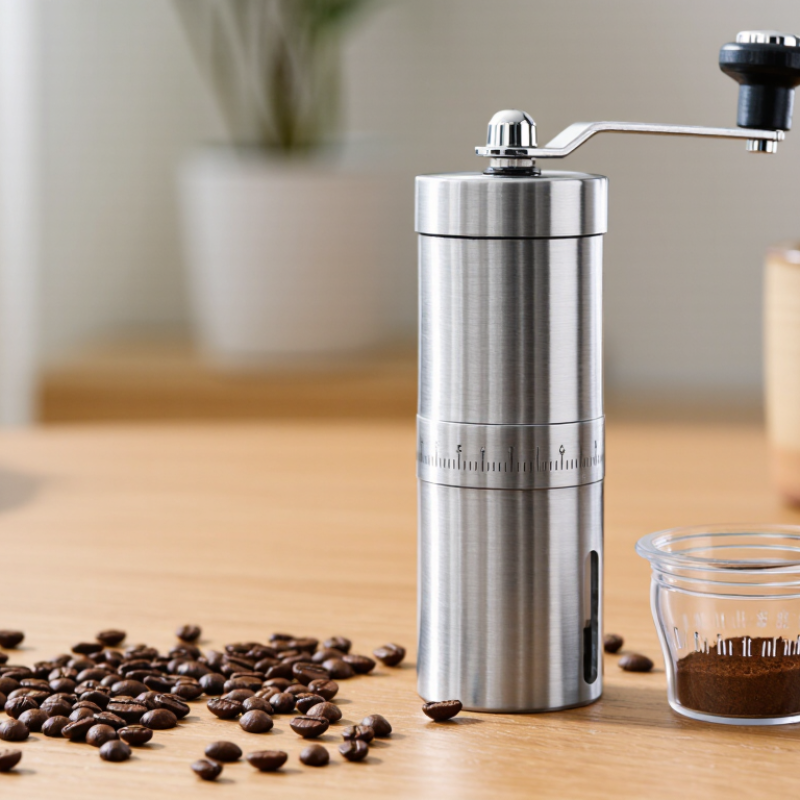
A high-quality hand coffee grinder begins with consistent burr alignment. When the burrs stay centered, grounds look more uniform across different settings. This matters because uneven particles extract at different speeds. The cup may taste sharp, hollow, or strangely bitter. In daily use, a precise adjustment system makes small changes easy to repeat. Clear clicks help, but smooth stepless control can offer finer control. Neither system is perfect.
The grinder should also feel stable in the hand. A firm body, comfortable handle, and low wobble reduce fatigue during grinding. Quality bearings support smoother rotation and fewer unwanted movements. The burr material matters too, but it should not be judged alone. A durable burr can still perform poorly if its alignment is weak. Practical design wins here. A secure catch cup prevents spilled grounds, while simple disassembly supports regular cleaning.
Capacity and portability deserve honest attention. A compact grinder may suit one traveler, yet require several grinding rounds for a larger household. I once focused too heavily on grind speed and overlooked grip comfort. That was a mistake. A slower grinder can be better for daily brewing if it feels controlled and reliable. Buyers should inspect adjustment markings, replacement-part access, and manufacturing consistency. Small flaws may appear after months of use. A strong grinder is not merely attractive; it should deliver repeatable results, withstand routine handling, and remain understandable when something needs adjustment.
Top Hand Grind Coffee Grinder for Global Buyers? - What Defines a High-Quality Hand Coffee Grinder?
| Evaluation Dimension | High-Quality Benchmark | Useful Specification or Range | How Buyers Can Verify It | Why It Matters |
|---|---|---|---|---|
| Burr Material | Hard, wear-resistant burrs with stable alignment | Hardened stainless steel is commonly preferred for durability; ceramic can resist corrosion but may be more brittle | Check the material specification and inspect the burr edges for uniform machining | Burr condition affects grind consistency, service life, and flavor clarity |
| Burr Size | A burr large enough to balance speed and portability | Approximately 38–48 mm is a practical range for many travel and home hand grinders | Confirm the actual burr diameter rather than relying only on the external body size | Larger burrs generally process beans faster, although design and alignment also influence performance |
| Grind Consistency | A narrow particle-size distribution with limited fines and boulders | Consistent results across coarse, medium, and fine settings; no universally accepted single percentage standard | Grind the same dose three times and compare particle appearance and brew drawdown | More uniform particles promote more predictable extraction |
| Adjustment System | Secure, repeatable adjustment with clearly defined settings | External stepped adjustment is easy to repeat; stepless adjustment offers finer control but requires careful tracking | Check whether the dial moves smoothly and remains fixed during grinding | Repeatable settings simplify dialing in different brewing methods |
| Brewing Range | Suitable for the buyer's intended brewing methods | Fine settings for espresso, medium settings for filter coffee, and coarse settings for immersion brewing | Verify the manufacturer’s supported range and test for clogging or excessive effort at fine settings | A wide range improves versatility, but usable consistency is more important than the number of settings |
| Grinding Speed | Efficient grinding without excessive heat or frequent stalls | Many manual grinders process a 20 g dose in roughly 30–90 seconds, depending on burr size, bean density, and grind setting | Time three 20 g grinding tests using the same beans and setting | Shorter preparation time improves convenience for daily use |
| Grinding Effort | Smooth rotation with limited wobble and manageable resistance | No universal force rating exists; effort varies with roast level, bean density, burr geometry, and grind size | Test light, medium, and dark roasted beans while checking handle comfort and shaft stability | Lower strain makes the grinder more suitable for repeated daily preparation |
| Dose Capacity | Capacity matched to the intended serving size | Approximately 20–30 g is suitable for many single-serve brewing routines; larger capacities may require a taller body | Weigh the beans before and after loading to confirm the usable capacity | Adequate capacity reduces the need for multiple grinding cycles |
| Retention | Minimal coffee retained inside the burr chamber and chute | A low-retention design should leave only a small residue after tapping and brushing; exact results depend on grind size and bean type | Weigh the grinder before and after grinding, then repeat after light tapping | Low retention improves dose accuracy and reduces stale coffee buildup |
| Alignment and Bearing Stability | The inner burr remains centered with minimal lateral movement | A rigid shaft supported by quality bearings is preferable; tolerance values should be supplied by the manufacturer when available | Rotate the handle empty and check for wobble, scraping, or uneven resistance | Stable alignment is essential for uniform particle production |
| Body and Handle Ergonomics | Comfortable grip, secure base, and a handle that does not loosen during use | A textured body, balanced weight, and a removable or foldable handle can improve portability | Hold the grinder with one hand and turn the handle continuously for at least one full dose | Good ergonomics reduce fatigue and the risk of accidental drops |
| Cleaning and Maintenance | Tool-free or simple disassembly with accessible burrs | Burrs should be brush-cleanable; most coffee grinders should not be washed with water unless the instructions explicitly permit it | Review the cleaning instructions and confirm that replacement or removable parts are available | Regular cleaning helps preserve flavor and adjustment accuracy |
| Portability | Compact, durable, and easy to protect during transport | A travel-friendly design commonly fits inside luggage or a coffee kit and weighs approximately 0.5–1.0 kg | Check packed dimensions, total weight, handle storage, and protective case options | Portability is important for travelers, campers, and mobile coffee preparation |
| Material Safety and Durability | Food-contact components made from suitable, corrosion-resistant materials | Stainless steel, anodized aluminum, and food-safe polymers are commonly used in coffee equipment | Request material disclosures and inspect threads, coatings, seals, and contact surfaces | Appropriate materials support long-term use and easier maintenance |
| Replacement Parts and Support | Clear instructions and access to wear parts such as burrs, bearings, or adjustment components | Support availability should cover the buyer’s region and expected service period | Confirm parts availability, warranty terms, delivery coverage, and after-sales contact channels | Repairability can reduce long-term ownership cost and product waste |
| Best Buyer Profile | Users who value control, portability, and independence from electricity | Especially suitable for home brewing, travel, camping, and small-batch preparation | Match the grinder’s capacity, adjustment range, and effort level with the planned routine | The best grinder is determined by use case rather than specifications alone |
Note: Performance ranges are practical reference values rather than universal industry standards. Actual results vary with burr geometry, bean density, roast level, grind setting, and user technique.
FAQS
Conical burrs often grind efficiently and provide a forgiving workflow. Flat burrs may separate flavors more sharply. They need steadier alignment.
Larger burrs usually grind faster and reduce repeated passes. However, they can add bulk and weight. Bigger is not always better for travel.
Hardened steel usually keeps a stable cutting edge during frequent grinding. Ceramic resists corrosion but may feel slower with hard beans. Results can vary.
Pour-over needs even particles and precise adjustment steps. French press needs coarse settings and stable grinding. Espresso requires fine control, strong bearings, and more effort.
Confirm that it fits inside your backpack without sharp edges or loose parts. A removable handle saves space. A secure catch cup protects clothing from spilled grounds.
Yes, it usually suits one or two cups. Smaller bodies save space but may grind slowly. My smallest grinder became frustrating during several rushed mornings.
Keep the dose and water temperature consistent. Record grind size, grinding time, and flavor notes. Your first impression may be wrong.
Brush residual grounds from the burr chamber regularly. Avoid washing internal parts unless instructions clearly allow it. Check alignment, too. Small errors can change the cup.
Conclusion
Choosing the right Hand Grind Coffee Grinder requires more than comparing appearance or price. A high-quality manual grinder should provide consistent particle size, smooth adjustment, comfortable handling, and durable construction. Burr material, burr shape, body design, and grinding efficiency all affect flavor, effort, and long-term reliability. Global buyers should also consider whether the grinder is compact, lightweight, and easy to clean, especially when it will be used for travel or limited storage.
The best choice depends on the brewing method and personal preferences. Fine, precise adjustment may suit espresso, while broader settings can support pour-over, French press, or other brewing styles. Before buying internationally, check product dimensions, included accessories, replacement-part availability, packaging quality, shipping conditions, payment security, and applicable import requirements. By evaluating performance, materials, portability, maintenance, and after-sales support together, buyers can select a dependable manual coffee grinder that delivers fresh, balanced results in different environments.
