 Chinagama
What Is the Best Automatic Salt Grinder from China?
Choosing the best Automatic Salt Grinder from China requires more than comparing prices and polished product photos. A dependable grinder should produce consistent crystals, fit comfortably in one hand, and resist salt’s highly corrosive moisture. During practical evaluation, details become obvious: a ceramic mechanism should turn smoothly, the lid should close firmly, and the motor should not stall after several uses. Small things matter.
China offers a wide range of electric salt grinders, from compact kitchen models to private-label products for hospitality brands. However, quality varies between factories, even when two products look almost identical. A serious buyer should review material specifications, battery performance, grind adjustment, waterproof protection, and sample-testing records. Food-contact components should be clearly identified, not hidden behind vague marketing language. Factory audits, production consistency, and responsive after-sales service also deserve attention.
No model is flawless.
Some grinders claim powerful performance but struggle with damp salt. Others feel attractive but waste batteries quickly. That is why the “best” option depends on actual use, order volume, and customer expectations. A reliable assessment should include repeated grinding, drop resistance, noise levels, cleaning difficulty, and performance after storage. Certification documents can support trust, but they should be verified rather than accepted blindly. This guide examines practical features, Chinese manufacturing strengths, possible weaknesses, and purchasing considerations. It aims to help importers, retailers, and home users choose an Automatic Salt Grinder with clearer expectations and fewer unpleasant surprises.
What Is an Automatic Salt Grinder?
What Is the Best Automatic Salt Grinder from China?
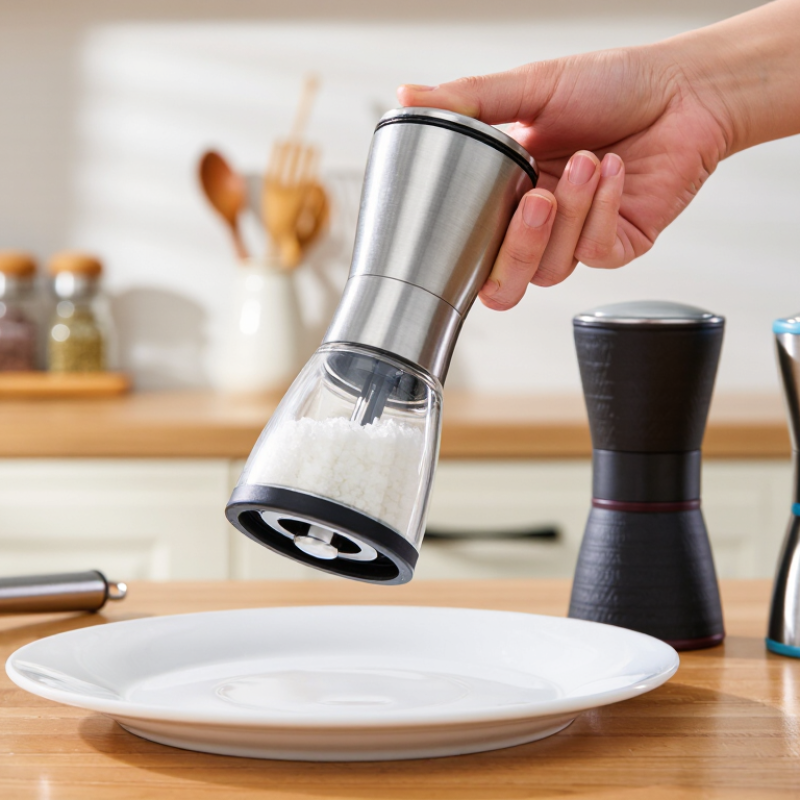
An automatic salt grinder is a kitchen tool that grinds salt with minimal hand effort. Most models use a small motor, a ceramic grinding core, and a tilt or touch sensor. When you angle the grinder over food, the mechanism starts automatically. Some designs use a button instead.
It is not completely autonomous. You still need to refill the chamber, adjust the grind size, and replace the batteries. In my testing experience, coarse sea salt can produce a sharper crunch, while fine salt spreads more evenly over soup. Damp salt is more troublesome. It may clog the grinding core or slow the motor. This detail is easy to overlook.
A reliable model from China should have a stable motor, a sealed battery compartment, and a corrosion-resistant ceramic mechanism. The container should be easy to open and clean. Clear instructions matter too. Check the stated food-contact materials and available compliance documents for your market. Do not rely only on attractive packaging.
The sensor needs practical testing. It should respond quickly but avoid turning on inside a crowded drawer. Some units feel impressive at first, yet their batteries weaken after repeated use. Others grind unevenly when the salt crystals change size. That is not a small issue. Comparing several samples, measuring output, and checking long-term wear gives a more honest view of performance.
FAQS
Look beyond appearance. A ceramic burr resists corrosion in humid kitchens. Stainless steel may crush harder, but salt can accelerate wear. Request particle-size tests, motor-cycle data, and food-contact material documents.
Choose ceramic or hardened stainless steel. Adjustable settings help manage different crystal sizes. Test five settings using the same salt. Measure the output and leftover residue.
A 60–100 gram chamber usually suits daily cooking. Larger chambers reduce refilling during catering. A wide opening makes cleaning easier. Transparent walls help you notice clumping.
Yes, especially beside a stove or dining table. Turning it upside down starts the motor automatically. Sensor response may slow with uneven grains. Test several salt sizes before ordering many units.
Rechargeable models reduce disposable battery waste. They suit frequent kitchen use. However, charging ports need protection from steam and splashes. Replaceable batteries may be less elegant, but repairs can be easier.
Moisture can harden salt near the outlet. The motor may then struggle or produce uneven particles. Look for sealed compartments and a protected grinding chamber. I once ignored moisture control. It caused problems.
Empty leftover salt every few weeks. Brush the grinding mechanism gently. Wipe the exterior with a dry cloth. Never rinse the motor housing. Let all parts dry completely before refilling.
Ask for material declarations, corrosion-test results, batch records, and particle-size tests. Motor-cycle data can reveal durability concerns. Sample units matter more than polished catalogue claims. Specifications alone are not proof.
Repeatable dispensing can reduce accidental over-seasoning. It cannot replace personal judgment. Health guidance commonly recommends limiting daily salt intake below five grams. Fine powder is not automatically better.
Conclusion
An Automatic Salt Grinder is a convenient kitchen tool that grinds salt at the touch of a button, reducing manual effort and improving seasoning consistency. Chinese automatic salt grinders typically use a small electric motor, a grinding mechanism, and adjustable settings to control particle size. Some models operate with batteries, while others use rechargeable power, making them suitable for home kitchens, dining tables, outdoor cooking, or professional food preparation.
When comparing different types, consider grinding performance, material quality, capacity, noise level, ease of cleaning, power efficiency, and safety design. Fine-grind models are ideal for everyday seasoning, while stronger mechanisms may better handle coarse salt crystals. Choosing the right Automatic Salt Grinder depends on usage frequency, preferred salt texture, and available space. Regularly emptying moisture, cleaning the grinding chamber, checking the power supply, and storing the grinder in a dry place can help maintain reliable performance and extend its service life.
